
Your Preference Is Irrelevant
In agent-maintained systems, stack choice follows what the AI already understands.
Your Preference Is Irrelevant
Your favorite language is no longer a strategy.
Your preference is irrelevant. If an autonomous agent will generate, test, and maintain most of the code, pre-AI language and framework tastes are no longer first-order decision criteria. What matters is what the agent already reads fluently: the languages and frameworks with the densest public corpora, the most predictable syntax, the richest open documentation, and the best tool surfaces.
This is a standalone follow-on to earlier arguments. When AI Reads Your Work established that agents treat documentation, tests, and comments as primary context. The AI Engineer Mindset asked what changes when engineers orchestrate agents instead of writing every line by hand. The next consequence is harder: if the agent is the primary maintainer of code, stack selection must optimize for the agent, not for historical team taste.
TL;DR
- For greenfield and agent-maintained systems, pre-AI language/framework preference is no longer a primary decision variable.
- Choose by agent fluency: training-data density, syntactic predictability, open docs/forums, MCP support, and forkability.
- Python leads on local generation density and several public agent benchmarks; TypeScript/JavaScript remain strong product surfaces despite more variable benchmark resolve rates.
- Readability is an agent capability metric: if the agent can read it, it can write, test, and maintain it.
- Frameworks win by public intelligence density, not brand loyalty or prior team habit.
- Human constraints still override at the margins: compliance, hard performance, legacy cores.
- The hiring signal is shifting from language expertise to AI orchestration skill.
Where the Premise Leads
Those earlier pieces established that agents read. This article examines what they read most fluently, and why that fluency now dictates stack choice.
The claim is not that every human preference is worthless. It is narrower and stronger: for systems that agents will maintain, prior personal or team preference is no longer the default decision rule. Compliance, hard real-time performance, and deep legacy integration still matter. Product work, internal tooling, data pipelines, content sites, and most agent-facing surfaces do not get to hide behind “this is what we already know.”
In practice, stack selection collapses to four filters, applied in order:
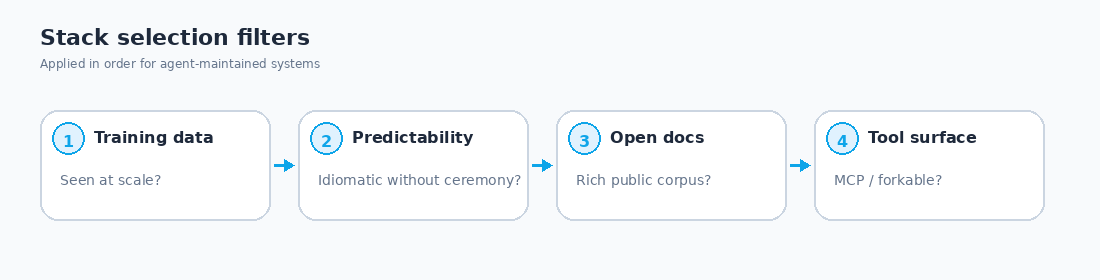
That is the decision rule.
Evidence from Euler and This Site
The Euler solutions and the site you are reading form a living laboratory for this claim. The Euler project is especially useful because it is multi-language by design, and because the project itself is now agent-generated and agent-maintained.
Euler: Six Active Languages, One Agent Corpus
The current Euler tree contains solutions for problems 1-100 in six active languages: Python, JavaScript, Java, Go, Rust, and C++. The root README is explicit about the shift: after the ai_takeover tag, AI-assisted generation became the default workflow.
That multi-language structure is not a museum of human skill. It is a controlled comparison of agent fluency under the same problem set, the same mathematical targets, and the same verification constraints. This article uses Euler as supporting evidence only. A deeper treatment of the Euler project and the multi-language agent experiments behind it will appear in a future article.
Measured across all 100 solutions in each active language, average solution size differs sharply. On the shared first 30 problems, the gap is even clearer: Python averages about 25 lines per solution, JavaScript about 40, Rust about 51, Go about 70, and C++ about 72. Problem 1 makes the point without rhetoric. The Python solution is an eight-line pure function. The Rust and C++ versions require more scaffolding for the same arithmetic result.
Average lines per solution (problems 1–100)
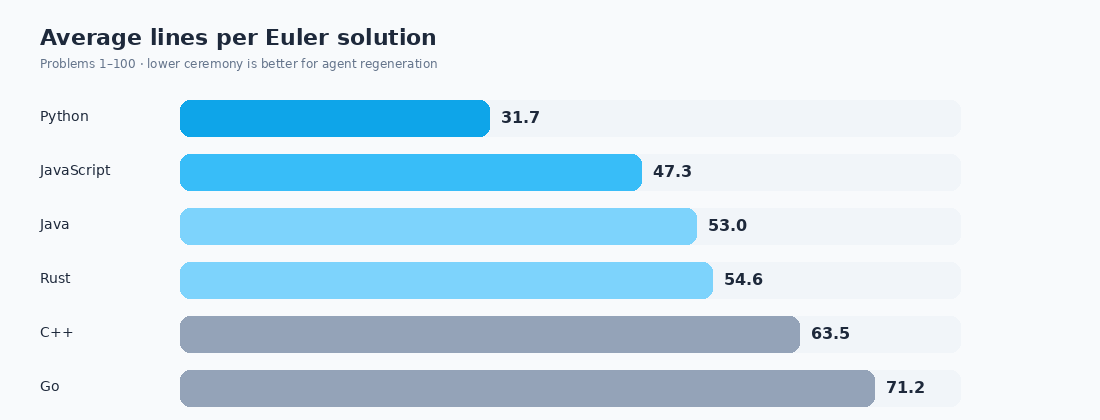
These numbers do not prove that Python is “better” mathematics. They show that agent-generated Python carries less structural overhead for the same problem class. Java sits in the middle: more ceremony than Python or JavaScript, less than C++ or Go. Less overhead means less room for hallucinated ceremony, fewer files to keep coherent, and a denser training pattern for the agent to reproduce.
The generation workflow itself reinforces the point. Local prompting instructs agents to read existing solutions in other languages before writing a new one: fetch the problem statement, inspect the target language conventions, study the previous solution in that language for style, and read the corresponding C++ implementation for algorithm and optimization patterns. The agent is not inventing in isolation. It is translating across a multi-language corpus under explicit instructions.
That same prompt also exposes process friction. C++ needs Makefile and unittest wiring. Rust needs module registration in main.rs. Python, JavaScript, Java, and Go are largely auto-discovered. That is agent friction expressed as process, not just syntax. The languages with less ceremonial surface area leave more of the context window for the actual algorithm.
This Site: Public Framework Intelligence Compounds
This site is generated with Astro and Tailwind. Astro’s model is explicit: frontmatter, template, and script remain separate; routing is file-system based; there is no deep convention-over-configuration layer hiding state transitions. When the agent needs to add a new article, the workflow is mechanical:
- Create the Markdown file with correct frontmatter
- Verify the schema against existing entries
- Update the writings index
- Confirm the hero image reference
It can do this without a private tutorial on Astro because Astro’s source, documentation, issues, and community discussion are public. The agent has already absorbed the pattern from open source. The novel work is applying that pattern to this content model, not reverse-engineering the framework itself.
Contrast that with a framework whose internals are closed, sparsely documented, or discussed only behind corporate wikis. The agent has little prior corpus to draw from. Every custom extension becomes a research project instead of an application of existing knowledge. That is the real cost of low public intelligence density.
Why Language Choice Is Now an AI Decision
Public agent benchmarks already show that language is not neutral. SWE-Bench Pro reports language-sensitive resolve rates: Go and Python tasks generally resolve better, while JavaScript and TypeScript are more variable and often harder. Multi-language evaluations such as SWE-bench Multilingual reinforce the broader point: agent performance is language-sensitive and corpus-sensitive.
These are related but distinct signals. Benchmark resolve rates measure success on real repository tasks. Local generation density measures ceremony cost for the same algorithm. Euler speaks to the second signal: Python is most compact, JavaScript next, Java middleweight, and Rust/C++/Go more scaffolding-heavy.
The mechanism is a popularity feedback loop. Alexandru Nedelcu puts it cleanly in Programming Languages in the Age of AI Agents:
“A programming language’s popularity is a feedback loop. These days, because Python is popular, having available a huge training corpus, ‘AI’ agents can be successful at generating Python scripts that work, making Python even more popular.”
The loop
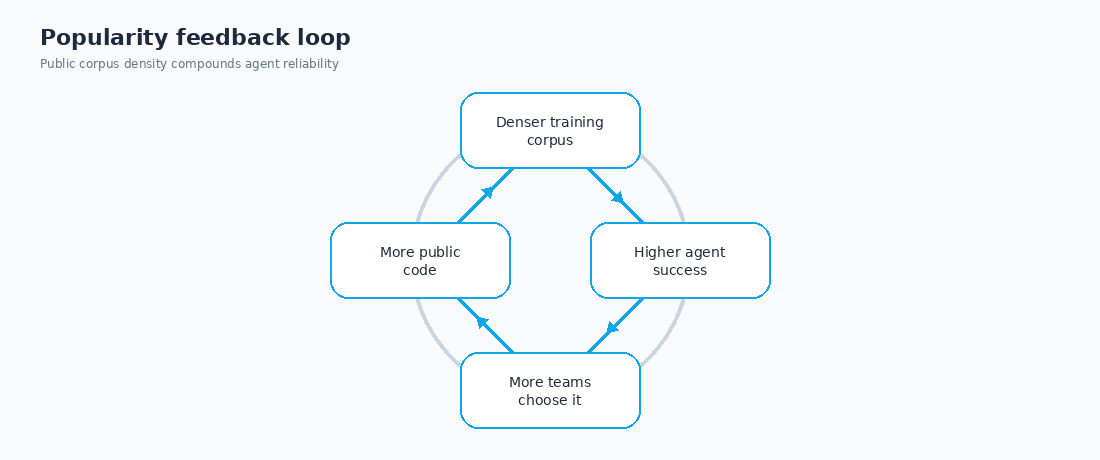
The same loop operates, at smaller scale, for TypeScript and JavaScript.
The practical implication is blunt. Language selection is no longer primarily a team preference. It is a model preference. “We already know Java” is not an argument unless it is paired with a hard constraint. The useful question is “what has the model already learned at scale?” If the model has seen orders of magnitude more well-documented Python than Rust, the agent will usually be more reliable in Python for the same class of task.
This is not a temporary artifact of one model generation. As long as agent capability is driven largely by learning on public corpora, the languages with the largest public footprints will remain the ones agents understand most deeply. For product, tooling, and content workloads, that existing knowledge is now the dominant selection criterion.
Why Framework Selection Follows Documentation and Open Source Richness
Framework choice used to be driven by runtime characteristics, hiring pools, and the polish of official marketing pages. In the agentic era the criteria shift:
- How much public documentation, GitHub discussion, Stack Overflow Q&A, and tutorial content exists for this framework?
- Is the source open and forkable, or is critical behavior hidden behind proprietary layers and enterprise licenses?
- Does the framework expose an MCP-compatible surface so the agent can call operations without custom glue?
- How many real-world code examples has the agent already seen that use this exact pattern?
A framework with sparse public discussion but excellent runtime performance often loses to a framework with rich public discussion and slightly worse benchmarks. The agent can learn the popular framework from training data and then customize or fork it. The agent cannot invent the obscure framework from nothing without a high hallucination rate.
Open source is therefore not merely a licensing preference. It is an agent capability multiplier. The more open the source and discussion, the more the agent can treat the framework as prior knowledge rather than new research. MCP support extends this further: if operations are exposed as callable tools, the agent can compose them without reconstructing internals.
This also changes the economics of custom frameworks. Because agents can read source, docs, and forum history, it is now more feasible to fork an almost-right open-source framework than to adopt a closed one and hope the vendor abstractions fit. Forking becomes an agent-executable evolution path.
Framework fitness for agents
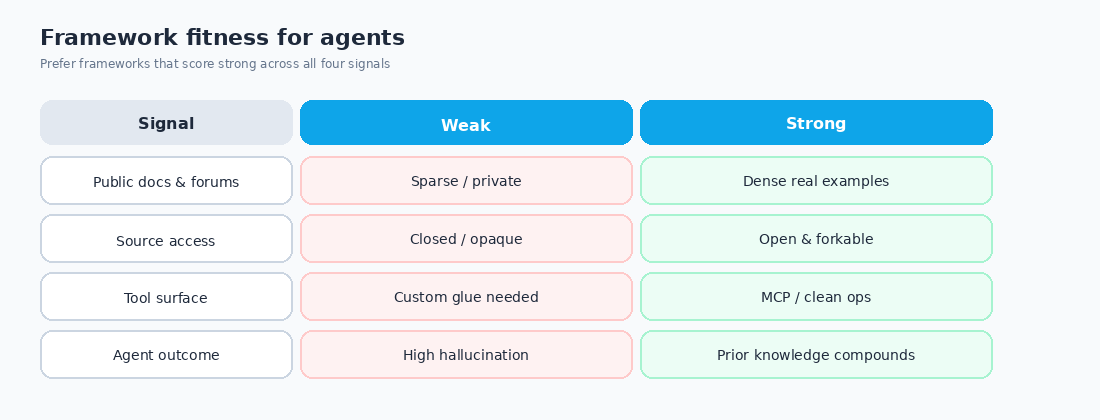
Prefer frameworks that score strong across the matrix. Conditional use is fine when only the tool surface is weak. Reject when docs and source are both thin.
In short: frameworks are selected by the richness of the intelligence surrounding them. AI reads the docs and writes the code. If the docs, forums, source, and tool interfaces are rich, the agent is rich. If they are thin, the agent is thin. The Model Context Protocol is one reason tool surfaces now matter as much as APIs: agents increasingly consume software through explicit, callable interfaces rather than through tribal knowledge.
The Readability Imperative
If agents succeed when syntax is predictable and public discussion supplies missing patterns, the operative criterion is no longer human cognitive load. It is model fluency.
“Perfection is achieved, not when there is nothing more to add, but when there is nothing left to take away.” — Antoine de Saint-Exupéry
That is usually treated as design advice for humans. It is now also an agent criterion. A language hard for humans to read is usually hard for agents to read. A framework that hides behavior behind magic is hard for agents to extend safely. The symptoms are the same: hallucinated APIs, more correction cycles, and latent bugs the agent cannot detect.
Euler makes this concrete. The same Problem 1 answer can be a compact Python comprehension or a longer C++ function with includes and build wiring. Both are correct. One is denser for an agent to regenerate, test, and maintain.
The practical test is simple. Give the agent a well-defined task. Measure correction cycles and final test-pass rate. The lowest-friction option is the one the model already reads most fluently. That is the new readability metric.
When Human Criteria Still Override
This shift is not universal. Human-era concerns still dominate in several domains:
- Regulatory and compliance environments. HIPAA, SOC2, and financial audit requirements may mandate languages and libraries with certified tooling histories. The agent’s preference is irrelevant if the compliance checklist requires a specific stack.
- Performance-critical hot paths. Real-time trading engines, game physics, cryptographic primitives, and embedded firmware still justify C, C++, or Rust for cycle-level control. The agent’s iteration cost is the price of hard constraints.
- Legacy system integration. When the work is extending a fifteen-year-old mainframe interface or a Fortran numerical core, the agent often operates at the boundary layer while humans own the core.
- Mixed teams and brownfield codebases. Introducing agentic AI into an existing project is not the same problem as choosing a greenfield stack. Ownership boundaries, review culture, tribal knowledge, and partial migration paths all change the calculus.
For greenfield product development, internal tooling, data pipelines, web applications, and most agent-facing surfaces, agent criteria now lead. For everything else, the human constraint remains the constraint.
Euler itself illustrates the split. The project keeps C++ and Rust solutions because they are educational and performance-relevant, while still using them as reference implementations for agents generating solutions in other languages. Hybrid judgment, not ideology.
The Resume Shift: From Language Expert to Agent Orchestrator
If language choice is now an AI decision, the hiring signal must change with it.
“The purpose of abstraction is not to be vague, but to create a new semantic level in which one can be absolutely precise.” — Edsger W. Dijkstra
Abstraction used to mean cleaner code for humans. Now it also means cleaner interfaces for agents. That is the modern hiring filter. Listing “expert in Java” or “expert in Python” is becoming a weaker differentiator where agents generate and maintain most of the code. The stronger signal is orchestration skill: defining constraints, keeping context coherent, measuring correction cycles, designing agent-readable interfaces, and knowing when to force a human override.
Language knowledge is not worthless. Its value has moved. The engineer who thrives can make an agent reliable in the chosen language, detect false confidence, and redesign the surrounding system so future agent work stays coherent.
In architecture reviews, the new gate is simple: can an agent maintain this? Tribal knowledge and hidden framework magic fail the gate. Explicit, documented, open, toolable design passes.
Actionable Recommendations
-
Audit your stack by agent friction. Measure correction cycles on representative tasks. The highest-friction language or framework is the first candidate for deprecation or isolation behind an agent-friendly boundary.
-
Default to Python or TypeScript/JavaScript for most agent surfaces. Use Python when generation density and benchmark reliability matter most; use TypeScript/JavaScript when the product surface is the web and public framework intelligence is dense. Override only for hard human constraints.
-
Choose frameworks by public intelligence density. Count documentation quality, issue activity, tutorial volume, forum depth, and open-source availability. Prefer frameworks the agent has already seen extensively over frameworks that are technically elegant but sparsely documented.
-
Treat forkability and MCP support as first-class criteria. If the agent can read the source and call the operations, it can evolve the framework. Closed or opaque frameworks are agent dead ends.
-
Measure readability as agent capability. The test is not “can a human read this easily?” The test is “does the agent generate correct, testable code on the first or second attempt?”
-
Accept the human onboarding cost. If the agent thrives in a language your team does not know, the training investment is often cheaper than years of slow agent iteration in a more familiar stack.
-
Once the stack is agent-fluent, keep the surrounding docs agent-readable. Stack choice buys fluency. Documentation, tests, and constraints keep that fluency pointed at your actual system.
-
Hire and promote for orchestration skill. Prefer candidates who can make agents coherent across a codebase over candidates whose primary claim is solitary mastery of one language.
The New Default
If agents consume your writing as infrastructure, they also shape which language and framework that infrastructure should be written in.
So the hard sentence stands: your preference is irrelevant for agent-maintained systems. Pre-AI language and framework tastes remain relevant only where hard human constraints still dominate. Everywhere else, the default decision rule has changed.
Do not start with what the team likes. Start with what the agent already reads fluently. Choose that stack. Then teach the humans enough to supervise it.
Two follow-on pieces belong next. One will cover introducing agentic AI into mixed teams and existing projects: migration paths, review gates, partial rewrites, and human-agent coherence in stacks not chosen for agents. Another will go deeper into the Euler experiments: project design, multi-language generation workflow, correction cycles, failure modes, and what those results actually measure about agent fluency.
Original articles and writings are not covered by the site's MIT LICENSE (which applies only to code and template).