The Audience: When AI Reads Your Work
Your code reads better to machines than humans now. So does everything else you write.
The Audience
You’re onboarding an AI agent to a complex legacy system. You point it at the repo and give it a feature request. The output is functional but fundamentally misunderstands the system’s constraints, security model, and performance characteristics.
The root cause? Documentation written for humans, not the machines now reading it with perfect but context-blind recall.
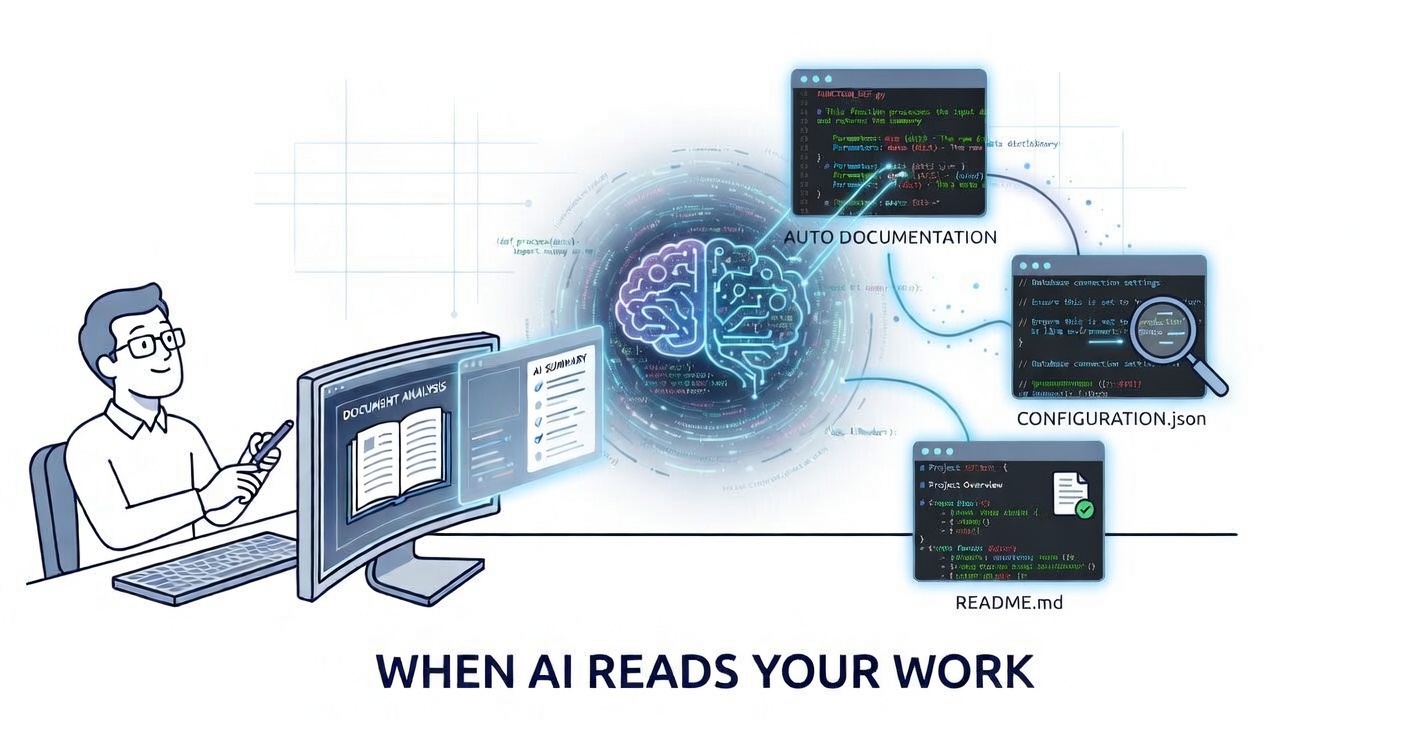
LLMs and autonomous coding agents parse your entire documentation corpus—READMEs, comments, tests, wikis—with perfect recall but without human intuition. This creates both unprecedented opportunity and new failure modes. The same principle now extends far beyond code into every form of written communication we produce.
TL;DR
- AI treats all written material as primary context rather than supplementary reading
- READMEs function as system prompts; tests as behavioral contracts; communications as style and intent signals
- Intent-driven comments, structured docs, and consistent external writing reduce hallucinations and improve coherence
- Concrete practices across code and non-code writing yield measurable improvements in agent reliability, personal representation, and output quality
- All forms of writing are now infrastructure for AI-native workflows
The Shift: Documentation and Communication as Context Infrastructure
We once maintained docs and communications as checkboxes for human collaborators who might never read them in full. Comments were afterthoughts. Tests were strictly for verification. Emails and messages were ephemeral. Web posts were for human audiences.
Today, every line is ingested repeatedly by tools that lack our implicit knowledge of the domain, history, and preferences. One notes, with some irony, that agents don’t just read your code docs—they analyze your email threads for decision history, review IM conversations for context clues, and study your web posts and articles to understand your voice and expertise.
The cruel irony: documentation, once the most painful and time-consuming part of the engineering job—the part we procrastinated, delegated, or quietly resented—must now become essential daily practice. What was drudgery is now infrastructure. (This raises the inevitable question of context bloat and token limits, a topic for a future article on context management strategies.)
“Programs must be written for people to read, and only incidentally for machines to execute.” — Harold Abelson & Gerald Jay Sussman (Structure and Interpretation of Computer Programs)
Recent work on context files demonstrates that well-structured base materials allow AI to generate supporting documentation that outperforms sparse human efforts. Quality of written output directly correlates with AI effectiveness across your professional and public presence. Your lazy README haunts you exponentially now.
README.md: The AI Onboarding Manual
Your README is no longer a polite welcome mat—it’s the foundational context window for any agent entering your codebase. Agents parse it first to build their understanding of scope, conventions, and constraints. A weak README forces the AI to make assumptions that compound through subsequent interactions.
Ineffective (human-centric):
- Vague setup steps that assume institutional knowledge
- High-level feature lists without implementation details
- Boilerplate contribution sections that don’t address AI-assisted contributions
Effective (agent-optimized):
- Self-contained architecture summaries with visual diagrams in multiple formats
- Verifiable one-command bootstrap sequences including dependency graphs and environment variables
- Non-functional requirements, scaling considerations, and invariants spelled out with examples
- Dedicated sections on core mental models, common pitfalls with real scenarios, and debugging decision trees
- Sample interaction patterns, effective prompt templates tailored to the domain, and examples of past AI contributions
Successful patterns include dedicated instruction files that define boundaries, preferred reasoning approaches, and escalation paths for when the agent encounters ambiguity. Note that an overlarge README can cause context bloat. Keep the core file focused on mental models, invariants, and bootstrap instructions, factoring detailed content into linked supporting files (ARCHITECTURE.md, ADRs) or llms.txt for prioritization. When agents can bootstrap correctly from docs alone, downstream tasks succeed at higher rates with fewer clarification loops. This reduces token usage and improves overall efficiency in long-running agent sessions.
Documentation: Structured Knowledge for Inference
Beyond READMEs, detailed specs, architecture decision records (ADRs), API references, and module overviews serve as the long-term memory for AI systems working across your project over extended periods.
Practices that matter for both humans and AI:
- Machine-readable consistency through standardized headings, metadata tags, and cross-linking conventions
- Emphasis on tradeoffs, rejected alternatives, and the context in which decisions were made
- Rich cross-references between documentation, code implementations, test cases, and related communications
- Living documents updated alongside code changes with clear change logs and rationale
- Historical context and system evolution to help AI understand why certain patterns exist
LLM performance benchmarks consistently show significantly better results on tasks with rich, structured supplementary documentation versus code-only context. The AI can better maintain consistency with original design goals and avoid introducing regressions when this knowledge is explicitly available.
Comments: Encoding Decision Rationale
Inline comments have evolved from simple developer notes to critical signals that shape how AI reasons about your implementation choices and maintains fidelity to original intent over time.
Low-value patterns to eliminate:
- Redundant restatements of obvious code logic
- Generic TODOs without associated context, owners, or acceptance criteria
- Comments that duplicate information available elsewhere in docs or tests
And then there are the comments that were never meant to see the light of day—filled with profanity, insults aimed at never-ending bugs or the original author (sometimes by name). AI will read them too. A summary could end up in a generated distributed status report.
High-value patterns that provide leverage:
- Direct links between specific code and underlying business or domain requirements
- Detailed documentation of performance, security, or compliance considerations that influenced the approach
- Notes on subtle interactions, gotchas discovered during development, or environmental assumptions
- References to related test cases, email discussions, or IM threads that validate or explain the logic
- Forward-looking comments about planned extensions or known limitations for future AI work
“Documentation is a love letter that you write to your future self.” — Damian Conway
These comments allow AI to reconstruct the original engineer’s intent and decision-making process rather than inferring solely from implementation details. This leads to more coherent extensions, refactors, and feature additions that stay true to the system’s foundational principles.
Tests as Behavioral Contracts
Test suites function as both executable validation and formal specification for AI agents, providing concrete, verifiable examples of expected system behavior.
They excel as unyielding behavioral contracts—the only language an LLM can’t misunderstand or creatively misinterpret—because:
- Descriptive test names and structures clearly articulate intended behavior in natural language that AI maps directly to requirements
- Individual assertions encode exact input/output boundaries, leaving no room for “creative” edge-case handling by the agent
- Failing tests deliver immediate, grounded debugging targets complete with reproducible scenarios, rather than vague bug reports
- Gaps in coverage naturally highlight areas where knowledge remains dangerously implicit or tribal
- Integration with CI provides ongoing, ruthless validation that AI changes haven’t broken core functionality
Engineering teams consistently report that directing agents with precise instructions like “update this feature while keeping all existing tests green and adding coverage for new paths” produces far more reliable and maintainable results than vague or high-level requirements. This approach turns your test suite into a powerful constraint system that channels AI creativity within proven boundaries.
The Expanding Sphere: Emails, IM Messages, and Web Posts
The audience shift extends well beyond your codebase. AI systems now routinely generate and consume emails, instant messages, web posts, blog articles, and social content on our behalf.
Emails: AI systems draft responses, summarize long threads, and extract action items. Clear, structured emails with stated context, decisions, and follow-ups become the reference corpus for how AI should represent you. Vague or emotionally charged messages can lead to inappropriate tone in AI-generated replies. Consistent structure—context, decision, action items, rationale—helps AI maintain professional coherence. Your 2am passive-aggressive reply will be studied and replicated.
I once realized, mid-conversation with a vendor, that my AI was effectively talking to their AI via email—we were merely clicking Send.
IM Messages: Slack, Teams, and similar platforms generate massive volumes of conversational context. AI tools analyze these for project status, blocker identification, and decision history. Fragmented threads or ambiguous “thumbs-up” emojis confuse agents attempting to extract requirements. The lost context of an unthreaded “sure” becomes a major roadblock for an LLM trying to reconstruct a decision. Using threaded discussions, explicit summaries, and searchable keywords improves AI’s ability to synthesize accurate overviews and suggestions.
Web Posts and Public Content: Your blog posts, articles, social media, and documentation sites are crawled and used to understand your expertise, voice, and positions. Inconsistent messaging across platforms leads to AI producing content that doesn’t align with your established thought leadership. Maintaining a unified voice through style guides applied to all public writing ensures AI extensions of your work feel authentic.
This broader corpus means documentation discipline must become a universal habit. The same principles of clarity, structure, intent communication, and stated constraints apply to all written output. Teams and individuals who extend these practices to emails, messages, and web content see improved AI assistance across their entire workflow—not just coding tasks.
Practical Implementation Steps
- Self-audit: Have an AI agent summarize your project’s architecture, recent decisions from emails/IMs, and public voice using only your current materials. Note gaps and inconsistencies. Prepare to be humbled.
- Standardize for parseability: Adopt consistent formats, metadata, and linking conventions across code docs, emails, messages, and web content.
- Elevate tests and examples: Focus on descriptive naming and comprehensive coverage as primary specification artifacts in both code and communications.
- Close the loop with AI: Regularly use agents to critique, summarize, and enhance your documentation, emails, and posts for clarity and AI-friendliness.
- Quantify results: Track metrics including successful first-attempt task completion rates, hallucination frequency, tone consistency in generated communications, and time saved in synthesis tasks.
For teams, practical documentation extends to shared context files (AGENTS.md equivalents), standardized decision records, and routine AI-assisted knowledge base maintenance—turning collective tribal knowledge into reliable agent fuel. For leaders implementing these practices at scale, see The AI Engineering Transformation for organizational frameworks and measurement strategies.
Establish systems and processes that create source-controlled documentation in easy-to-consume Markdown. Yes, it makes the repository larger, but everything becomes AI-consumable.
Coda
All forms of writing have undergone a phase change. What was once a maintenance burden or casual communication is now core infrastructure for reliable AI collaboration and personal representation. The documentation you skipped writing in 2023 because “the code is self-explanatory” is now costing you in agent hallucinations, misrouted decisions, and emails drafted in a voice you don’t recognize.
Individuals and teams that treat their entire written output with discipline gain compounding advantages. The rest are training their replacements to misunderstand them with perfect fidelity.
“The great enemy of clear language is insincerity.” — George Orwell
You and your teammates are no longer the audience. Our AIs are.
Further Reading
- The AI Engineer Mindset: Orchestration techniques and metacognitive practices for directing AI agents effectively
- “A Survey on Code Generation with LLM-based Agents” (arXiv:2508.00083): “Code generation agents powered by large language models (LLMs) are revolutionizing the software development paradigm.”
- “From LLMs to LLM-based Agents for Software Engineering” (arXiv:2408.02479): “LLM-based agents… combine LLMs as the core for decision-making and action-taking, addressing some of the inherent limitations of LLMs such as lack of autonomy and self-improvement.”
- “Codified Context: Infrastructure for AI Agents in a Complex Codebase” (arXiv)
- “Why Your AI Agents Need Contextual Documentation” (Hyperdev): “Documentation structure measurably affects AI accuracy.”
Original articles and writings are not covered by the site's MIT LICENSE (which applies only to code and template).