The AI Engineering Transformation
A leader's guide to organizational change, hiring, team structures, and measuring ROI in the age of AI agents
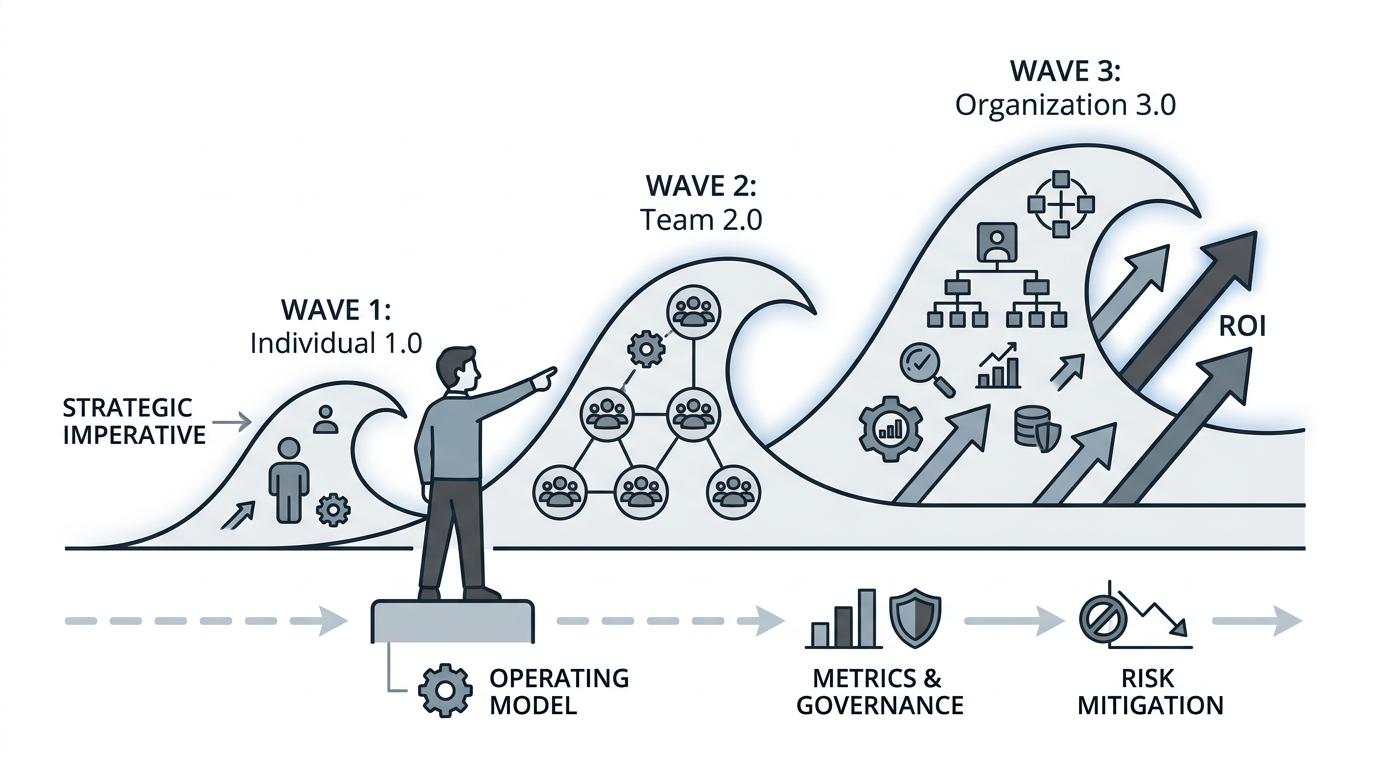
The AI Engineering Transformation: A Leader’s Playbook
A 3-Part Series
The bottleneck has shifted from typing speed to orchestration capability—how effectively your organization directs AI tools determines competitive outcomes.
This series provides a practical framework for engineering leaders to transform their teams from individual contributors into high-velocity AI orchestrators. Drawing from real case studies and quantitative research, it covers the strategic imperative, common failure modes, maturity frameworks, hiring practices, team structures, standardization principles, measurement approaches, and risk mitigation strategies.
The Series
Part 1: Why Now & How It Fails
The strategic imperative, failure modes, and three-wave framework
Why AI transformations fail, how to avoid the pitfalls, and the maturity model from individual productivity to competitive advantage.
Part 2: Organizational Design
Hiring for judgment, team structures, and standardization
Building AI-effective teams through judgment-based hiring, guilds, councils, pods, and strategic standardization.
Part 3: Making It Real
Metrics, risk mitigation, and implementation
How to measure success, avoid common pitfalls, and implement a pilot-to-scale rollout plan.
Key Takeaways
- Operating Model Over Tools: Success depends on redesigned workflows, not just better AI assistants
- Judgment Trumps Speed: Hire for critical thinking and system understanding, not raw coding velocity
- Structured Collaboration: Guilds and councils create compounding knowledge advantages
- Quality Gates Matter: Reality testing pods prevent AI-introduced bugs from reaching production
- Personal AI Workflows: Each engineer should have customized AI configurations, not shared presets
- Measure What Matters: Track cycle time, defect rates, and business impact, not lines of code
- Three Waves: Individual → Team → Organizational transformation unlocks compounding advantages
Prerequisites
This series complements The AI Engineer Mindset, a technical series exploring practitioner-level orchestration techniques. Leaders implementing these changes should encourage their engineers to study both.
Citations
[1] METR Research (2025). Measuring the Impact of Early-2025 AI on Experienced Open-Source Developer Productivity. https://metr.org/blog/2025-07-10-early-2025-ai-experienced-os-dev-study/ (Note: Study published mid-2025)
[2] Index.dev (2025). AI Coding Assistant ROI: Real Productivity Data 2025. https://www.index.dev/blog/ai-coding-assistants-roi-productivity
[3] Faros AI (2025). The AI Productivity Paradox Research Report. https://www.faros.ai/blog/ai-software-engineering
[4] SoftwareSeni (2025). What the Research Actually Shows About AI Coding Assistant Productivity. https://www.softwareseni.com/what-the-research-actually-shows-about-ai-coding-assistant-productivity/