The AI Engineer Mindset
Introduction to the 5-part series exploring the fundamental shift in how engineers relate to creation, control, and cognition when directing AI agents.
The AI Engineer Mindset
A 5-Part Series
The cursor blinked accusingly at 2:47 AM. I’d been circling the same bug for hours, trapped in a mental cul-de-sac of my own making. The logic seemed sound on paper, the tests passed in isolation, yet in production the system degraded under load in ways I couldn’t trace. Frustrated, I typed one sentence into the AI chat: “This caching layer is failing under concurrent writes. Walk me through why my locking strategy might be insufficient and suggest three alternative mental models for the problem.”
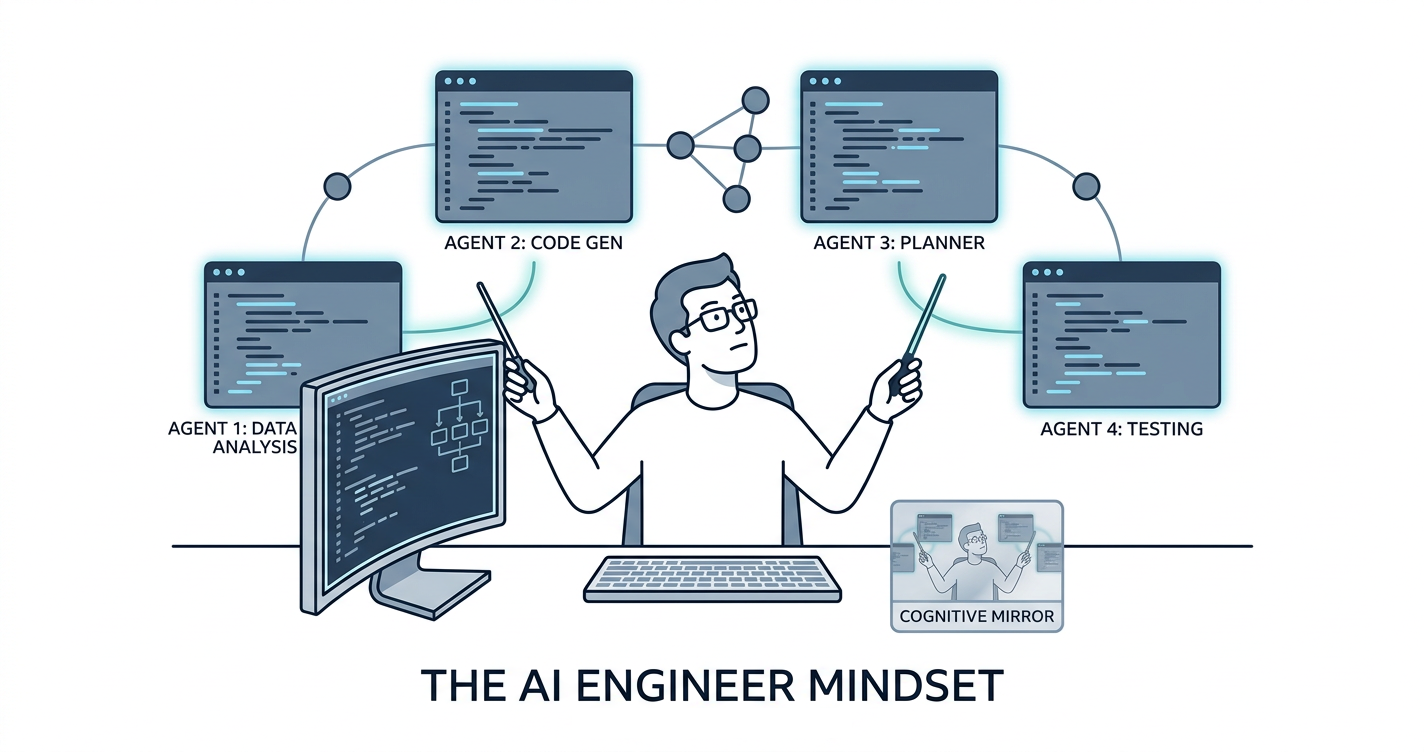
Thirty seconds later, the response didn’t just patch the error. It dismantled my entire approach, revealing that I’d been thinking about state management at the wrong level of abstraction entirely. The AI didn’t give me code—it gave me a new way to see the system. That single interaction crystallized everything about the AI engineer mindset. Not the tools. Not even the prompts. The fundamental shift in how we relate to creation, control, and cognition itself.
We didn’t simply gain a faster compiler or smarter autocomplete. We gained a mirror that reflects our thinking back at us at inhuman scale—and like any good mirror, it reveals both our hidden brilliance and our unconscious blind spots.
This series explores that mindset across five essential parts:
TL;DR - Series Overview
- Master AI orchestration through structured prompting and context control
- Develop metacognition to dialogue with software’s collective intelligence
- Balance creative exploration with rigorous reality testing
- Embrace conversational creation as the new engineering medium
- Operationalize the mindset with daily rituals and frameworks
The Series
Part 1: Orchestration and Control
Read Part 1
How to be the boss of AI agents, Socratic prompting, player vs. character knowledge, and the D&D analogy.
Part 2: Dialoguing with the Unconscious
Read Part 2
Interacting with the collective intelligence of software development, metacognition, and using AI as a thinking partner.
Part 3: Creative Tension
Read Part 3
The gardening metaphor and balancing creativity with rigor.
Part 4: Becoming Native to the New Medium
Read Part 4
Business impact, evolving skills, and becoming native to conversational creation.
Part 5: Practical Framework
Read Part 5
Daily rituals and practices to operationalize the mindset.
Why This Matters
The transformation is bigger than productivity. It’s a cognitive revolution comparable to the invention of writing or the scientific method. Just as those tools externalized memory and reasoning, AI externalizes intuition and synthesis. But only if you learn to direct it properly.
“We shape our tools and thereafter our tools shape us.” - Marshall McLuhan
Series Key Takeaways
- Shift from solitary coding to AI orchestration
- Master context, prompting, and metacognition
- Balance creative exploration with rigorous discernment
- Treat AI as a mirror for your own thinking
- Become native to conversational software creation
The full original essay has been distilled and expanded into this structured series for better digestibility and reference.
Start with Part 1: Orchestration and Control
(Word count: ~650)