Ongoing Principal Engineer / AI Architect
AI-Generated Euler Solutions
Chain-of-Thought Algorithm Optimization Polyglot Architecture C++ Java Go Rust Python Ruby PHP JavaScript
AI-Generated Euler Solutions
Role: Principal Engineer / AI Architect | Period: Ongoing
Overview
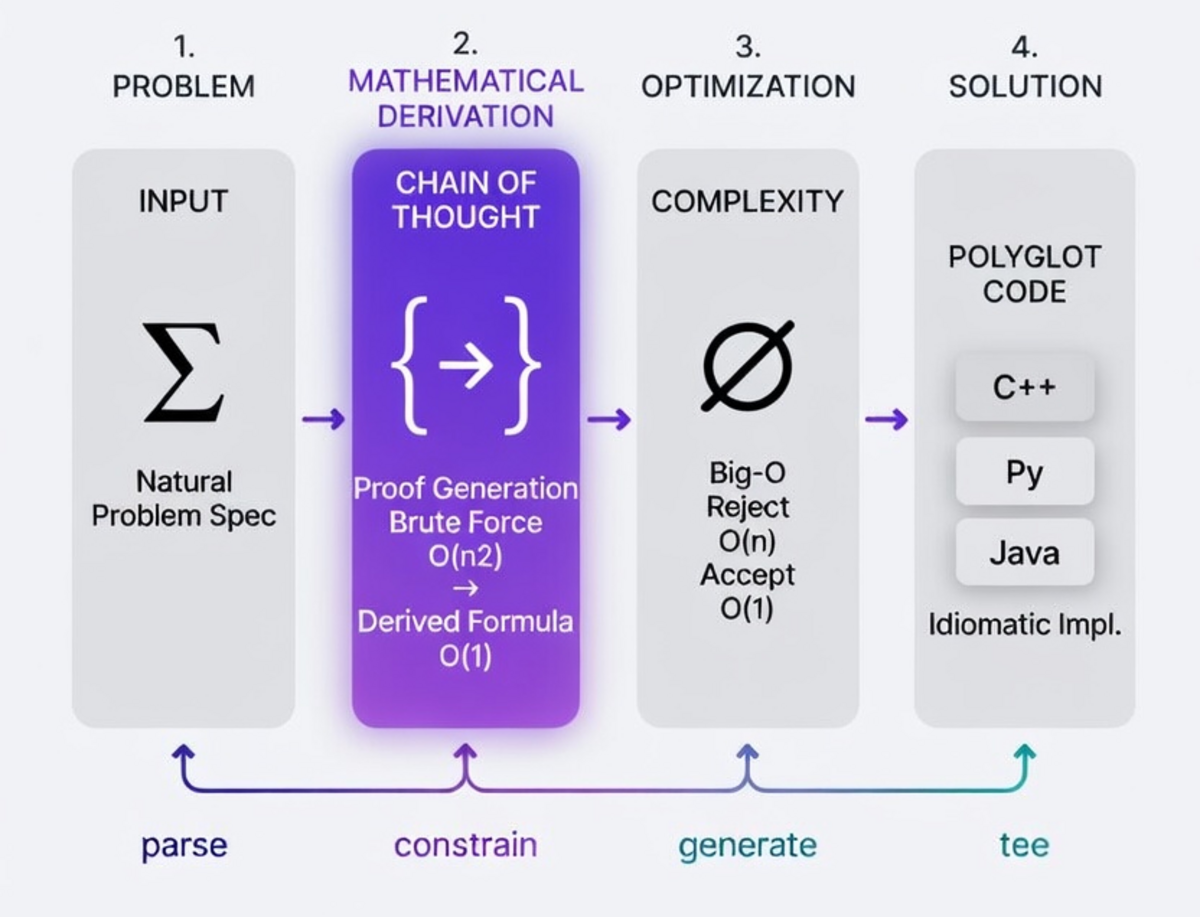
This repository (tvarley/euler) contains optimized solutions to over 50 Project Euler problems, 100% generated by autonomous AI agents. This project serves as a case study in guidance-based code generation. It demonstrates that while AI writes the code, it is the Senior Engineer’s expertise in algorithms and complexity theory that forces the AI to abandon brute-force attempts in favor of mathematically rigorous, optimal solutions.
Engineering the AI
🧮 Complexity & Optimization
- Enforced Rigor: Used specific “Chain-of-Thought” prompting strategies to force agents to derive the mathematical proof before writing code. This ensures solutions are based on number theory principles rather than inefficient iteration.
- Big-O Constraints: Distinct from standard “solve this” prompts, these agents were constrained to specific time/space complexity targets (e.g., or ), simulating a high-bar technical interview environment.
🌐 Automated Polyglot Architecture
- Automatic Translation: Leveraged initial prototypes as “specifications” for “translator agents,” enabling the rapid porting of mathematical logic across 7+ distinct programming languages.
- Idiomatic Enforcement: Agents were instructed to utilize language-specific paradigms—using
Goroutinesin Go,Streamsin Java, orSafety Checksin Rust, rather than producing generic, line-by-line translations.
🧪 Automated Verification
- Test-Driven Generation: Agents were required to generate the test harness alongside the solution. If the solution failed the generated tests, a “debugger agent” would analyze the failure, correct the mathematical logic, and re-implement the code autonomously.
Technologies
AI Methodologies
- Chain-of-Thought (CoT): For pre-computation mathematical derivation.
- Constraint-Based Prompting: Forcing adherence to Big-O performance metrics.
- Agentic Translation: Maintaining logic consistency across multiple programming languages.
Implementation Languages
- Systems: C++, Rust, Go (Optimized for raw execution speed, safety, and concurrency).
- Enterprise: Java (Demonstrating structured, object-oriented implementations).
- Scripting: JavaScript, PHP, Ruby, Python (Showcasing flexibility and rapid prototyping).