
2012 - 2014 Enterprise Architect
Enterprise SaaS Migration
Architecture Migration C# Node.js High Availability
Enterprise SaaS Migration
Role: Enterprise Architect | Period: 2012 - 2014
Overview
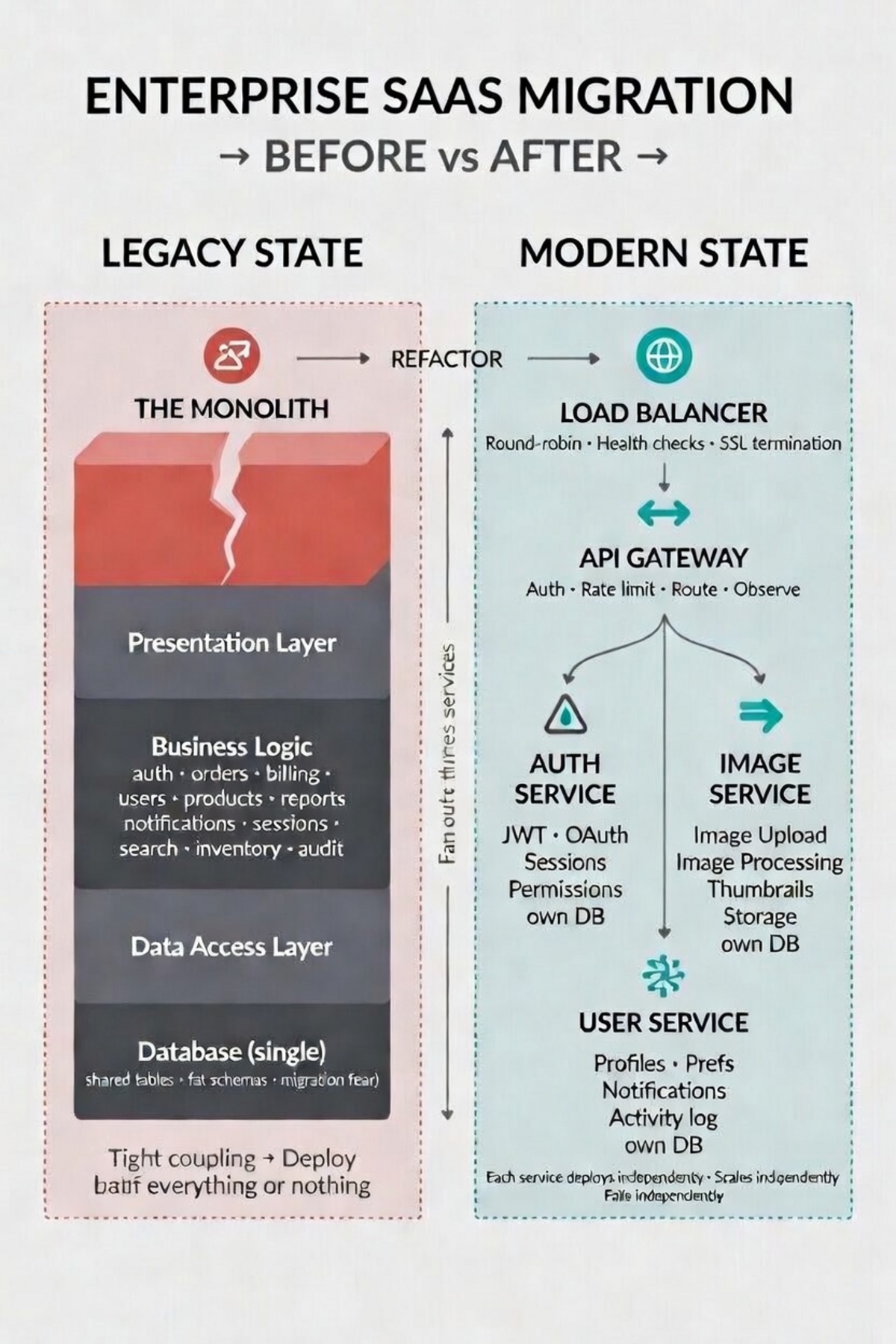 Spearheaded a high-stakes enterprise initiative to modernize a legacy monolithic software suite for a major B2B enterprise company. The project involved transforming a tightly coupled, on-premise style application into a **modern, cloud-native microservices architecture**. This transformation was critical to meeting the demands of a growing global user base and ensuring 24/7 availability.
Key Achievements
📈 Scale & Performance
- 170% Performance Boost: Realized a dramatic improvement in system response times and throughput through architectural decomposition and database optimization.
- Massive Scale Support: Engineered the new infrastructure to reliably handle over 3 million daily requests, supporting a vast network of enterprise clients.
- 99.9% Uptime: Achieved “nines” availability targets by designing self-healing systems and eliminating single points of failure.
- Vendor Selection: Led the rigorous evaluation and selection process for cloud providers and third-party tooling, ensuring optimal cost-performance ratios and strict compliance alignment.
🏗️ Architectural Transformation
- Monolith to Microservices: Successfully aligned business domains with bounded contexts, decoupling monolithic logic into independently deployable microservices.
- Global Resilience: Implemented robust autoscaling policies and Disaster Recovery (DR) protocols to ensure service continuity across multiple geographic regions.
- Hybrid Stack: Effectively bridged the gap between incumbent Microsoft technologies and emerging open-source standards.
Technologies
Languages & Frameworks
- C# / .NET: Retained for core business logic and complex domain modeling, leveraging its strong typing and enterprise ecosystem.
- Node.js: Introduced for high-throughput, I/O-bound edge services and real-time features.
Architecture Patterns
- Microservices: Decomposition of services based on business capabilities (SOA).
- Service Bus: Asynchronous logic handling for inter-service communication and decoupling.
Infrastructure & Operations
- Autoscaling: Dynamic resource allocation based on real-time traffic demand.
- Load Balancing: Layer 4/7 distribution to ensure optimal request handling and failover.
- Monitoring & Alerting: Comprehensive system health tracking to preemptively identify performance bottlenecks.