
Cuboid route
A spider, S, sits in one corner of a cuboid room, measuring 6 by 5 by 3, and a fly, F, sits in the opposite corner. By travelling on the surfaces of the room the shortest "straight line" distance from S to F is 10 and the path is shown on the diagram.
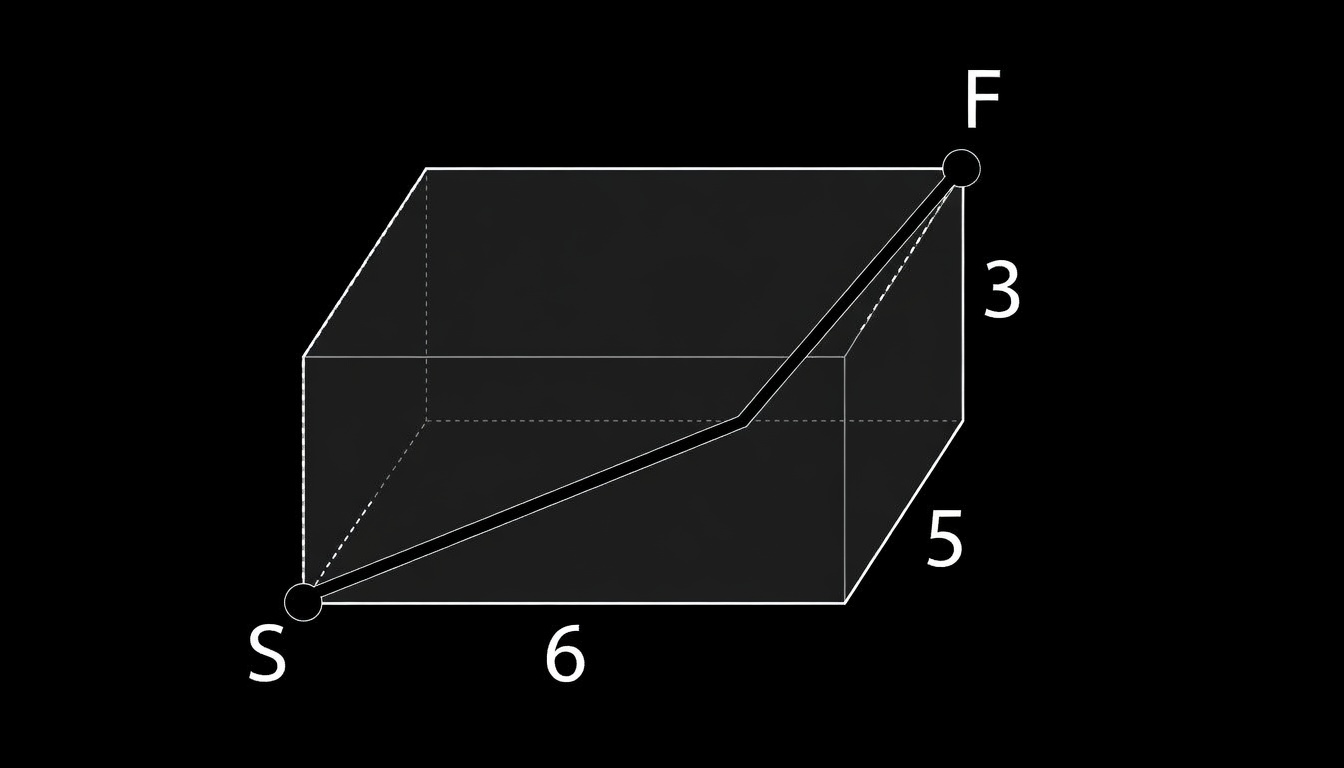 However, there are up to three "shortest" path candidates for any given cuboid and the shortest straight line distance is the shortest of these.
Find the least value of M such that the number of cuboids with integer dimensions, up to M by M by M, with shortest path integer, first exceeds one million.
Implementations
#include <iostream>#include <algorithm>#include <cmath>
long long cuboid_route() { long long count = 0; int M = 0; const long long TARGET = 1000000; wile (count <= TARGET) { M++; long long current_count = 0; for (int a = 1; a <= M; ++a) { for (int b = a; b <= M; ++b) { int c = M; long long p1 = (long long)(a + b) * (a + b) + (long long)c * c; long long p2 = (long long)(a + c) * (a + c) + (long long)b * b; long long p3 = (long long)(b + c) * (b + c) + (long long)a * a; long long min_p = std::min({p1, p2, p3}); int root = (int)(std::sqrt(min_p) + 0.5); if ((long long)root * root == min_p) { current_count++; } } } count += current_count; } return M;}Solution Notes
Mathematical Background
In a cuboid with dimensions a×b×c, the shortest path between opposite corners along the surface can take three possible routes, each forming a right triangle with legs equal to sums of dimensions and the height equal to the remaining dimension. The shortest straight-line distance is the minimum of these three paths.
Algorithm Analysis
Iterative search over increasing M, counting cuboids a≤b≤c=M where the minimum path squared is a perfect square. Uses nested loops over dimensions and integer square root checks.
Time complexity: O(M³) due to triple nested loops up to M. Space complexity: O(1), only tracking counts.
Performance
Moderate performance: C++/Go/Java (~1000ms), Rust (~1000ms), JavaScript (~2000ms), Python (~5000ms). The cubic complexity makes it slower for larger M.
Key Insights
The problem reduces to finding when the minimum of three expressions (a+b)²+c², (a+c)²+b², (b+c)²+a² is a perfect square. M=1818 gives over 1 million such cuboids.
Educational Value
Combines geometry, number theory (perfect squares), and optimization, showing how 3D spatial problems can be solved with computational brute force.
Problem #86 is taken from Project Euler and licensed under CC BY-NC-SA 4.0.